
Poll Finds Majority Support for Federal Ban After Supreme Court Sports Ruling
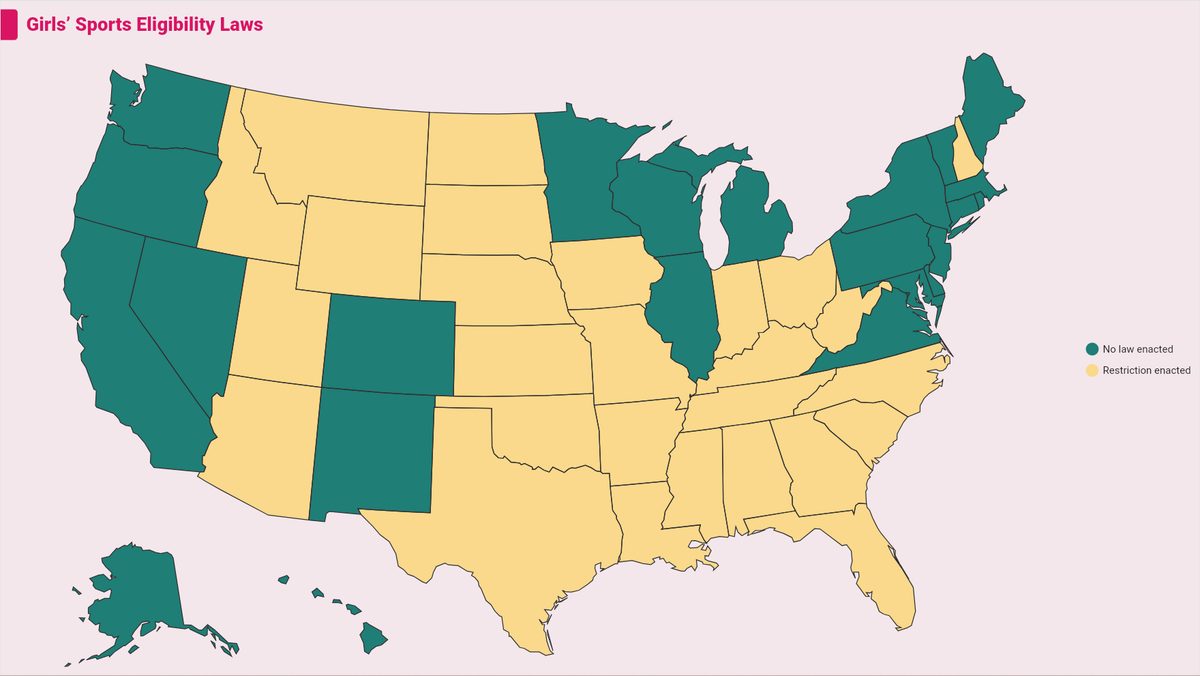
A recent Supreme Court decision has renewed national attention on how school sports teams are defined and who is eligible to participate. The case centered on laws in Idaho and West Virginia that limit girls’ teams to biological females, which were challenged under federal law.
Because the ruling interprets Title IX, it has implications for schools nationwide and for states that have already enacted similar policies. The issue continues to prompt a range of views about fairness, inclusion, and how participation rules should be set.
We wondered what Americans think about the June 30, 2026 Supreme Court ruling allowing states to bar biological males who identify as female from girls’ school sports teams. So we asked 585 registered voters (MoE of 4.1%) from July 6 to July 12, 2026 about it.
What voters said
A majority of respondents, 54%, said “There should be a federal ban from biological males in female sports,” making it the clear leading position in the poll. The next largest share, 15%, said “Sport participation should be based on gender identity instead of sex,” followed by 11% who favored evaluating participation “on a by individual case-by-case basis.”
Smaller groups selected other approaches: 8% said they “support the Supreme Court decision,” and another 8% said “fairness and inclusion should both be weighed, without a blanket rule either way,” while 4% chose “None of the above.” Overall, the distribution is uneven, with a majority coalescing around a federal ban and the remaining responses spread across several alternative viewpoints.
Across the political spectrum
Responses differ markedly across the political spectrum. On the Right, 90% chose “There should be a federal ban from biological males in female sports,” with similarly strong support among the Moderate Right at 83%. The Center also leans in that direction, with 64% selecting a federal ban, though smaller shares in this group support the Supreme Court decision (13%) or other options.
On the Left, the pattern shifts. A majority, 55%, chose “Sport participation should be based on gender identity instead of sex,” while 24% preferred case-by-case decisions and 11% favored weighing fairness and inclusion without a blanket rule. Among the Moderate Left, views are more mixed, with 28% supporting a federal ban, 21% backing case-by-case decisions, and 21% favoring a balanced approach. These differences illustrate a clear ideological divide in how respondents approach the issue.
Zooming out
The results show that while one position holds majority support overall, opinions vary widely depending on political perspective. As states continue to implement or consider policies under the Court’s ruling, these differing viewpoints are likely to shape ongoing debates about school sports and participation rules.