
ActiVote
← All analysis
October 11, 2020

Early Voting

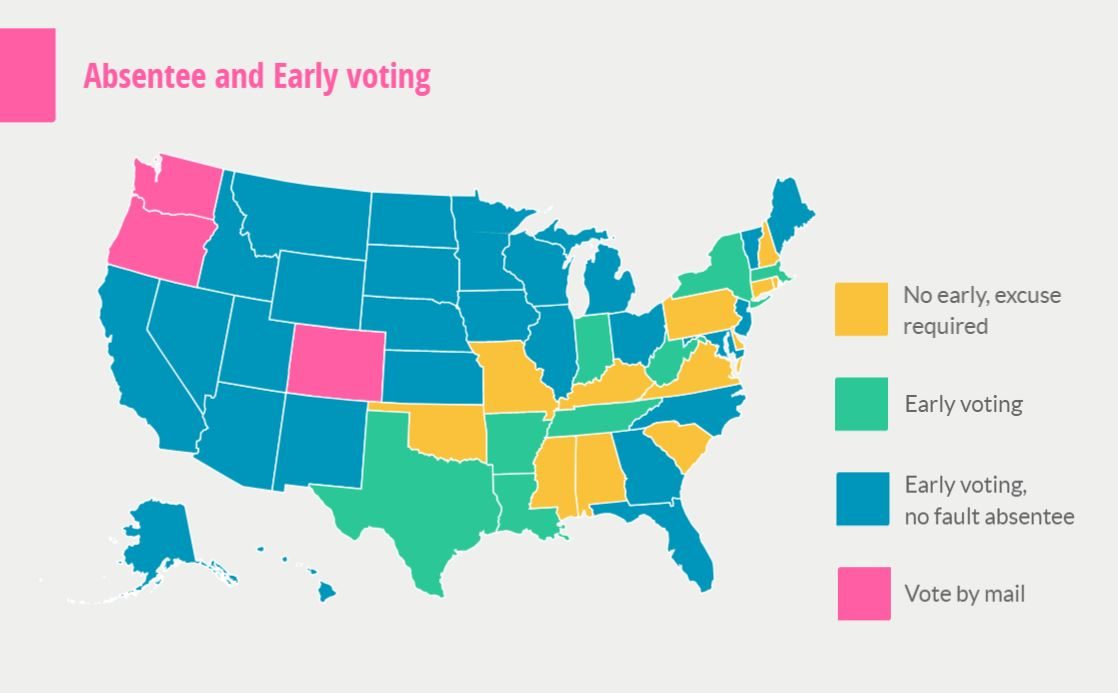
Early voting is underway in 20 states already, with another 20 to follow in the coming weeks. Some states don’t have no-fault absentee voting nor early voting, making election day voting the only option, while others have universal vote-by-mail allowing everyone to mail their ballot or drop their ballot off at their convenience.

ActiVote conducted a survey to determine what our users thought about the various options and whether they felt this state-by-state system is fine or that any particular solution should be adopted everywhere. We provided five options to choose from, which can be summarized as follows:

  • Vote-by-mail everywhere
  • Early voting everywhere
  • No-fault absentee everywhere
  • Leave to the states
  • Election day only (with few exceptions)
The headline result
vote-by-mail everywhere
29%
early voting everywhere
50%
no-fault absentee everywhere
3%
leave to states
8%
election day only everywhere
10%
See the details below →

Almost all our users (92%) feel that we should move away from the patchwork of rules created by the states, despite the constitution clearly leaving the responsibility of elections to those states.

About 82% seek a change that provides more options (no-fault absentee, early voting or vote-by-mail), while 10% would like to go back to just voting on election day by everyone.

The crosstabs
18-29
24%
52%
19%
30-49
32%
48%
13%
50-64
16%
55%
23%
65+
49%
41%
vote-by-mail everywhereearly voting everywhereno-fault absentee everywhereleave to stateselection day only everywhere
See the details below →

Those 65 and over are the strongest in their support for vote-by-mail. Perhaps this is the combination of this group being less mobile than younger voters and being regular users of the USPS.

The crosstabs
Dem
45%
53%
Rep
14%
39%
18%
25%
Ind
24%
55%
11%
vote-by-mail everywhereearly voting everywhereno-fault absentee everywhereleave to stateselection day only everywhere
See the details below →

Republicans stand out with 1 in 4 wanting to go back to election day voting only, while less than 1 in 10 of all others want that. Still, even among Republicans there is a majority (57%) that wishes any of the no-fault absentee, early voting or vote-by-mail all around the country.

Overall, a clear majority supports making voting easier.

The Details

The answers as asked

Charts and tables use the short label at the start of each line.

  1. vote-by-mail everywhere: We should move to a full vote-by-mail system as in OR, WA and CO, which all give full access to everyone.
  2. early voting everywhere: We should ensure early voting is an option nationwide, and implement it for all elections.
  3. no-fault absentee everywhere: We should ensure no-fault absentee ballot voting is possible, as this is a lower cost solution to early voting.
  4. leave to states: The current, somewhat diverse state-by-state situation is fine.
  5. election day only everywhere: All early voting options (except for absentee ballot voting for those with valid reasons) should be terminated, and people should vote on the day of the election.

The full crosstab table

ActiVote · Early Voting · October 11, 2020
ActiVote 358 RV vote-by-mail everywhere early voting everywhere no-fault absentee everywhere leave to states election day only everywhere
National ±5.2% MoE 29% 50% 3% 8% 10%
Gender Men 31% 45% 4% 11% 9%
Women 27% 57% 1% 3% 12%
Age 18-29 24% 52% 2% 19% 2%
30-49 32% 48% 5% 2% 13%
50-64 16% 55% 4% 2% 23%
65+ 49% 41% 0% 8% 2%
Ethnicity White 30% 48% 3% 9% 10%
Black 41% 45% 0% 14% 0%
Latino 29% 58% 1% 3% 10%
Education High school 43% 38% 2% 3% 14%
Some college 23% 58% 0% 16% 3%
Bachelor's 20% 53% 9% 3% 14%
Income <50k 33% 46% 4% 8% 9%
50k-100k 24% 53% 4% 12% 7%
>100k 32% 50% 1% 3% 14%
Affiliation Dem 45% 53% 0% 1% 1%
Rep 14% 39% 4% 18% 25%
Ind 24% 55% 2% 11% 8%
Region Dark Red 10% 66% 0% 24% 0%
Light Red 41% 46% 1% 7% 5%
Swing 23% 53% 6% 10% 7%
Light Blue 36% 40% 0% 3% 20%
Dark Blue 32% 46% 5% 2% 16%
Methodology. Fielded October 2020 among 358 registered voters nationwide. Responses weighted by Demographics and Spectrum. Average expected error ±5.2%. See Why trust our polls? for the methodology, disclosures and accuracy record.