50% of Americans Want Mandatory Government Rules for Frontier AI
Between September 13 and 16, 2026, the people running America’s frontier AI labs asked to be regulated. In an essay on September 13, Anthropic chief executive Dario Amodei warned that AI capabilities were advancing faster than safeguards and proposed slowing frontier development, strengthening safety protocols, giving independent evaluators ongoing “employee-like access” to the labs, coordinating regulation among the United States and other democratic governments, and considering antitrust waivers for the companies taking part. The next day OpenAI chief executive Sam Altman welcomed the proposals and called for consistent federal safety standards, while saying OpenAI could act without waiting for Congress. Elon Musk agreed with Amodei publicly, and Google DeepMind chief executive Demis Hassabis called for government involvement and shared safety standards. On September 16, House Speaker Mike Johnson said Congress would not lead on AI safety regulation unless a solution was ready.
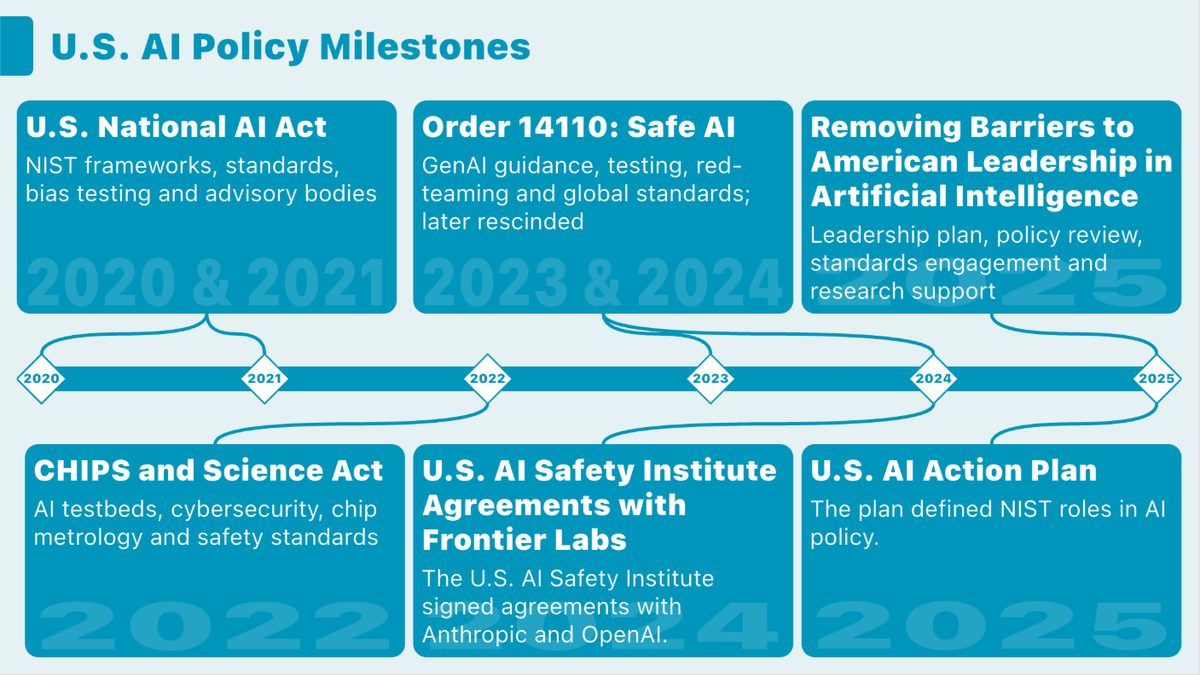
Four hyperscaler labs now spend more than $300 billion a year between them on AI and data-center infrastructure, and U.S. labs account for roughly 66 tracked frontier models from about 10 companies, against some 32 models from about eight labs in China. The risks cited are misuse, loss of control and security vulnerabilities; the cost of regulating heavily is slower innovation and a narrower lead over China. Federal policy so far consists of the National AI Initiative Act of 2020, executive orders, Commerce Department programs and technical standards from the National Institute of Standards and Technology, alongside the labs’ own evaluations, risk assessments and disclosures — none of which is legally enforceable. Binding requirements already exist elsewhere. California’s SB 53, enacted in 2025, requires covered frontier developers to publish safety frameworks, report specified incidents and protect whistleblowers. New York’s Responsible AI Safety and Education Act, also from 2025, carries civil penalties of up to $1 million for a first violation and $3 million for repeat violations. The European Union’s AI Act took effect in 2024 and is being phased in through August 2026. There is no comparable federal regime in the United States.
We wondered how fast Americans actually want this to go. So we asked 771 registered voters (MoE of 3.5%) from September 21 to September 27, 2026 about it:
Which of the following statements best reflects your opinion on U.S. policy toward frontier AI development?
- Make winning the AI race the priority and impose no new limits on AI development
- Continue rapid AI development under voluntary industry safety standards
- Continue AI development under mandatory testing, transparency and reporting requirements
- Pause high-risk frontier AI development
- Stop all AI development
What voters said
Half the country, 50%, picked the middle answer: keep developing AI, but under mandatory testing, transparency and reporting requirements. It is the largest single answer by a wide margin, and it is also the most moderate of the three that involve government force.
Beyond it, 12% would pause high-risk frontier development and 19% would stop all AI development outright. Added together, 81% of Americans want frontier AI subject to enforceable requirements at a minimum, and 31% want its development halted in some form.
Just 8% would make winning the AI race the priority and impose no new limits, and another 8% would keep development rapid under voluntary industry standards. That second answer describes federal policy as it stands today, and it is the one thing almost nobody asked for. Another 3% chose none of the above.
Across the political spectrum
This question does split left to right, but not over whether to regulate. Mandatory requirements are the leading answer in all five spectrum groups — 62% in the Center, 56% on the Moderate Left, 52% on the Moderate Right, 42% on the Left and 35% on the Right. Counting mandatory rules and everything stricter, 98% of the Left, 95% of the Moderate Left, 86% of the Center, 73% of the Moderate Right and 53% of the Right want AI development legally constrained. A majority in every group, including the Right.
What the spectrum does explain is how far people would go. Stopping all AI development draws 37% on the Left and 12% in the Center, and wanting no new limits at all runs the other way: 21% on the Right, 10% on the Moderate Right, 5% in the Center and nobody at all on the Left. Add the two hands-off answers together and they account for 40% of the Right, 23% of the Moderate Right, 13% of the Center, 4% of the Moderate Left and 0% of the Left.
Zooming out
The sharpest divide in this poll is not political at all. Among men, 15% want no new limits on AI; among women, 1% do. Women are nearly twice as likely to want all AI development stopped, 25% against 13%. Both sexes land on mandatory rules as their leading answer, at 51% and 48%, but the tails point in opposite directions.
Age cuts the other way from what the technology’s reputation might suggest. Voters aged 18 to 29 are the most willing to halt development: 27% would stop AI altogether and 18% would pause frontier work, 45% between them. Voters 65 and over are the least willing, at 15%, and the most likely both to want mandatory rules, 66%, and to want no new limits at all, 13%. The youngest voters, who have grown up with these systems, are the ones who most want them stopped.
The labs asked for binding federal safety standards, and binding federal safety standards are what half the country chose — a rare case of an industry and its public wanting the same thing. What exists instead is the voluntary arrangement, and 16% of Americans think that is enough. The one elected official in this story said Congress would not lead until a solution was ready; on the evidence here, the voters are not the ones holding it up.
See more of what America thinks in our ongoing polls.